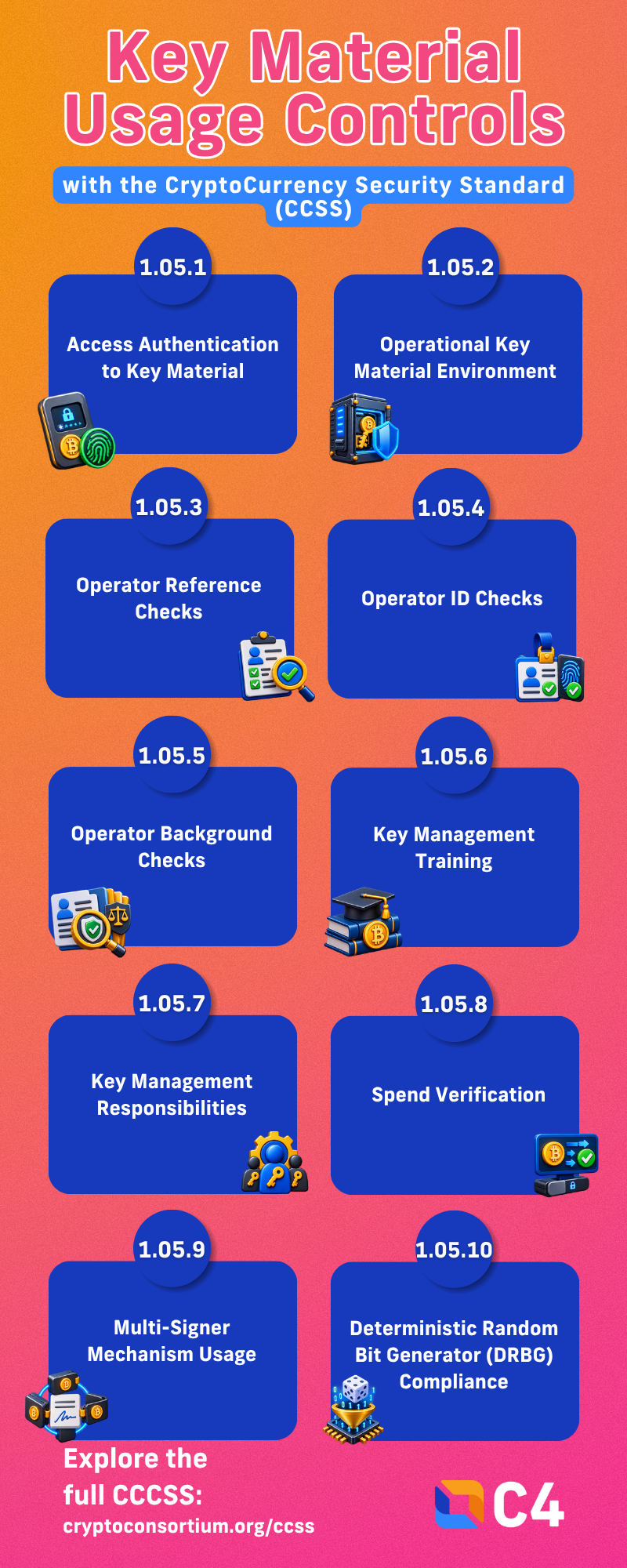
CryptoCurrency Security Standard (CCSS) Aspect 1.05
1.05.1 Access Authentication to Key Material
Aspect Control Overview: This aspect requires that there must be an identifier and at minimum 2 distinct types of authentication factors in order to access the operational key material. Multi-factor authentication reduces the risk of unauthorized access through the confirmation of identity in multiple ways.
Examples of authentication methods:
- Google Authenticator tokens
- Digital Signatures from a private key
- In-person ID verification
- Possession of a physical key or token
1.05.2 Operational Key Material Environment
Aspect Control Overview: This aspect states that key material is only used within the CCSS Trusted Environment. The risk of unauthorized copies being made by malware or key material being stored in an unauthorized location is reduced. Within the CCSS Trusted Environment, key material is isolated from other operating systems and application processes to reduce the risk of unauthorized access or leakage. Key material should only be used within a secure and trusted environment to prevent copying or leakage.
1.05.3 Operator Reference Checks
Aspect Control Overview: This aspect requires that individuals with access to key material or key operations have undergone reference checks before achieving access. Reference checks help identify concerns in a person’s history that could present a security risk.
1.05.4 Operator ID Checks
Aspect Control Overview: This aspect ensures that actors associated with operations in key material have had their identity verified. Identity verification reduces the risk of both impersonation and social engineering attacks by ensuring that only verified individuals are granted access to sensitive key management activities.
1.05.5 Operator Background Checks
Aspect Control Overview: This aspect ensures that actors with access to key material have undergone background checks prior to access being granted. Where permitted by local laws and regulations, these checks are conducted periodically to identify potential risks. These background checks are performed by law enforcement personnel or investigative firms.
1.05.6 Key Management Training
Aspect Objective: This aspect assures that individuals involved in key management operations complete the corresponding applicable training. This involves any individual with the ability to impact the security of key material. Training is completed before an actor is trusted with access to key material and then annually. Training reinforces awareness of threats, risks, and controls related to key material and ensures personnel understand their responsibilities within the CCSS Trusted Environment.
1.05.7 Key Management Responsibilities
Aspect Control Overview: This aspect requires that roles and responsibilities that relate to key management are formally acknowledged in written defined terms by all individuals with access to key material. Documented acknowledgement ensures accountabilities and confirms that each individual understands their obligations to protect key material from unauthorized access or misuse.
1.05.8 Spend Verification
Aspect Control Overview: This aspect requires that the destinations and amounts of funds are verified through Approved Communication Channels prior to the use of key material.
1.05.9 Multi-Signer Mechanism Usage
Aspect Control Overview: This aspect ensures that key material used in multi-signer wallets is stored and operated on separate logical or physical devices. Separating key material reduces the risk that a single compromised device or process could expose sufficient key material to authorize unauthorized transactions. Using separate devices reduces the risk that unauthorized access or exposure could compromise enough key material to authorize a transaction.
1.05.10 Deterministic Random Bit (DRBG) Compliance
Aspect Control Overview: This aspect establishes that digital signature generation follows recognized cryptographic best practices to prevent weaknesses and protect transaction integrity. Compliance can be achieved through the use of a compliant deterministic random bit generator (DRBG), a deterministic signature scheme, or another mechanism that follows cryptographic best practices for the algorithms used by the Key Management System.
Click to learn more about the CCSS.
This article was written by Shreya Patel.